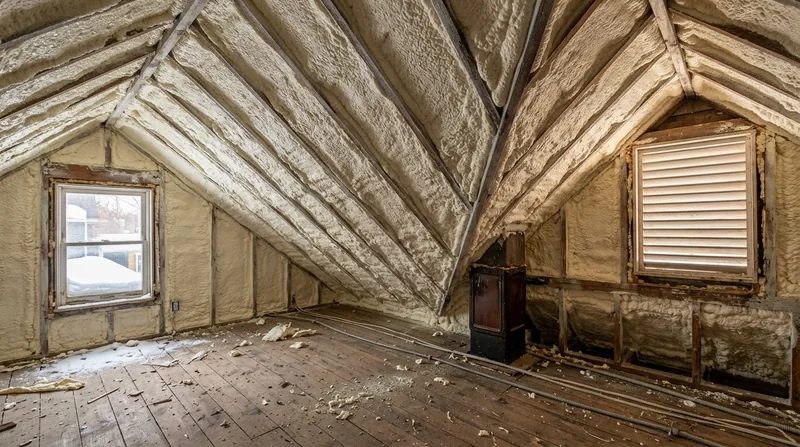




Attic spray foam insulation in Utica stops the heat loss that drives up winter energy bills and creates ice dams along the eaves every February and March. Utica's older housing stock, Victorians in Cornhill, mid-century ranches in New Hartford and Whitesboro, village homes in Clinton and Rome, sits over full basements and under roofs that collect heavy lake-effect snow. Warm indoor air rises through top plates and attic penetrations all winter long, and without proper air sealing and insulation, that moisture condenses inside the attic or wall cavity instead of moving safely to the outside. Spray foam across the attic deck closes those air leaks, raises the dew point above the insulation, and cuts the ice dam risk that threatens shingles and gutters. We have been installing spray foam insulation across the Mohawk Valley since 2012, and we know the specific failure modes that hit Utica homes hard.
Why Attic Spray Foam Insulation Matters in Utica: Ice Dams, Heat Loss, and Moisture Control
Ice damming is the signature winter problem for Utica attics. When warm air leaks from the living space into an uninsulated or poorly insulated attic, it melts snow along the roof edge. That water runs down and refreezes at the cold eaves, backing up under shingles and into the home. The root cause is air leakage at the attic perimeter combined with inadequate insulation. Spray foam stops both at once: it seals the top plates, rim joists, ductwork penetrations, and electrical chases where warm air escapes, and it provides the R-value needed to keep the attic deck cold in winter so meltwater does not form in the first place.
- Stops warm air from rising into the attic through top plates, electrical penetrations, and ductwork chases.
- Eliminates the temperature difference that causes ice dams along eaves and valleys.
- Prevents moisture condensation inside attic cavities and wall framing during the cold season.
- Reduces heating load and lowers winter energy costs across January through April.
- Creates a sealed roof deck that protects against both heat loss and moisture intrusion.
These five outcomes work together to protect the attic and cut ice dam risk for homes from East Utica to Rome.
Key info: A home in Cornhill with an uninsulated attic loses heat constantly through the winter. Once we spray foam the attic deck and seal the rim joist above the basement, that same home stays warmer and the eaves stay cold enough to prevent ice dam formation. The difference is felt in the heating bill and in the absence of water stains on the ceiling after a thaw.
For more information on how air sealing complements foam insulation, visit our air sealing service page.
New York State encourages homeowners to upgrade insulation and air sealing to reduce heating costs. You can verify the current energy code and permitting requirements for your address at your local building department website.
How We Install Attic Spray Foam Insulation in Utica: Process and Execution
Attic spray foam installation begins with a site visit and a detailed written estimate that specifies the R-value and thickness we will achieve. We inspect the attic for air leaks, existing insulation condition, roof structure, and any moisture or contamination that must be addressed before foam is sprayed. We then plan the foam application to seal the attic perimeter first, then cover the deck to the R-value your home needs. The entire process is controlled: correct drum temperature, manufacturer ratio, mechanical ventilation during cure, and a clear re-entry window of 24 to 48 hours before the space is safe to occupy.
- We inspect the attic structure, identify air leaks and existing insulation type, and assess moisture or contamination risk.
- We prepare the attic by protecting HVAC ducts, electrical components, and any areas that should not receive foam.
- We spray foam starting at the perimeter (top plates, rim joists, and penetrations) to seal air leaks first.
- We apply foam across the attic deck to the specified thickness and R-value, building to code.
- We provide mechanical ventilation during cure and a re-entry window before the attic is safe to use for storage.
This step-by-step approach ensures that every air leak is sealed and the insulation is applied at the correct thickness, so the job performs as designed.
Local example: A 1960s ranch in New Hartford with a vented attic and R-19 blown fiberglass gets 4 inches of closed cell spray foam across the deck and sealed rim joist. The foam stops air leakage at the top plate and creates a 1,200 square foot thermal boundary that cuts the heating load and eliminates ice dam risk. The job takes one day, and the home is ready for normal use within 48 hours.
If your attic also has rim and band joists that need sealing, learn more on our rim joist and band joist foam page.
Closed Cell vs. Open Cell Spray Foam for Attics: What Works in Utica
Closed cell and open cell foam are fundamentally different products, and the right choice depends on your attic's use and your climate. Utica's long, cold heating season and heavy snow load make closed cell spray foam the standard for sealed attic decks. Closed cell has a higher R-value per inch (typically R-6 to R-7), so 4 inches gives you R-24 to R-28 in a compact space. It also has a vapor barrier property that stops moisture from moving into the attic from below, which is critical in a climate where warm indoor air is constantly trying to rise into the attic during winter. Open cell foam is lower cost and offers sound dampening, but it is not a vapor barrier and requires a separate vapor retarder in cold climates, making it less suitable for sealed attics in the Mohawk Valley.
| Approach | Description | Best for |
|---|---|---|
| Closed Cell Spray Foam | High-density foam, R-6 to R-7 per inch, includes vapor barrier properties, resistant to moisture and air infiltration. | Sealed attic decks in cold climates, ice dam prevention, homes with high heating load. |
| Open Cell Spray Foam | Lower-density foam, R-3.5 to R-4 per inch, requires thicker application, allows vapor transmission, lower cost. | Sound dampening, attic spaces where vapor control is not critical, budget-conscious projects. |
| Blown-In Fiberglass or Cellulose | Traditional insulation, no air sealing capability, does not stop convective air movement, requires separate air barrier. | Top-up of existing sound attic insulation when air sealing is not needed, cost-sensitive retrofit. |
| Spray Foam Plus Air Sealing | Foam sealed to top plate, rim joist, and all penetrations, then covered with insulation to full R-value. | Complete thermal and air barrier in homes with ice dam risk, moisture problems, or high heating bills. |
For Utica homes, closed cell spray foam is the standard solution because it solves both the air leakage and the moisture problem in one application. Learn more about our closed cell spray foam insulation service.
Attic Spray Foam Insulation Cost in Utica: What to Expect
Attic spray foam insulation in Utica typically starts at $1.50 per square foot for closed cell foam at standard thickness (4 to 6 inches). The final cost depends on several factors: the total square footage of your attic, the complexity of the perimeter and penetrations to seal, the R-value you need to meet code or your heating goals, and the condition of existing insulation (if it must be removed first). A 1,200 square foot attic with a straightforward deck layout and no removal required might run $1,800 to $2,400. A larger attic with complex framing, multiple penetrations, or old insulation that must be removed first will cost more.
Getting two to three estimates is the smart approach. Each estimate should include the square footage, the foam type and thickness, the R-value, and the total price. Estimates that skip R-value and thickness, or that are far below market rate, are red flags. A detailed written estimate is also the clearest signal that you are working with a professional who knows the job and will stand behind the work.
For a full breakdown of pricing across all our services and to understand what moves the cost up or down, visit our pricing page. Call us at (315) 737-6731 for a free estimate with no obligation.
What to Look for When Hiring a Spray Foam Insulation Contractor Near Utica
Hiring the right spray foam contractor is as important as the product itself. The insulation trade has rig-and-run crews from out of state who spray a job in an afternoon and disappear when the smell will not go away, and it has national franchises with high overhead and regional pricing. A local independent shop with a local address and local plates is accountable to the community and has skin in the game. When you are evaluating any spray foam contractor near Utica, look for these markers of professionalism.
- Verify that the contractor is fully insured and can provide a current certificate of insurance on request.
- Ask for a written estimate that includes the square footage, foam type, thickness, R-value, and total price.
- Check references from recent jobs in Utica, New Hartford, or Whitesboro and ask about the contractor's responsiveness after the job.
- Confirm that the contractor understands local building code and will work with your building department on permitting if required.
- Ask about mechanical ventilation during cure and the re-entry window before the attic is safe to use.
- Verify that the contractor has experience with your specific attic type (vented, sealed deck, or cathedral ceiling).
A contractor who is willing to answer these questions clearly and provide documentation is one you can trust to do the job right.
Avoid red flags: An estimate with no R-value or thickness, a price far below market, immediate re-entry promised, or insurance that cannot be verified are all signs of a rig-and-run operation. A contractor who uses high-pressure sales or claims unlimited energy savings is also a marker of poor practice. Ask any contractor, including us, how they verify drum temperature, maintain manufacturer ratio, and provide mechanical ventilation during cure. If they cannot answer those questions clearly, walk away.
Ready to get started? Contact us at our contact page for a free, no-obligation estimate.
Attic Spray Foam Insulation in Utica: Pricing Guide
| Service | Price | Details |
|---|---|---|
| Closed Cell Spray Foam, Attic Deck | Starting at $1.50/sq ft | 4 to 6 inches, R-24 to R-28, includes perimeter sealing and air leakage control |
| Open Cell Spray Foam, Attic | Starting at $1.00/sq ft | 6 to 8 inches for equivalent R-value, lower cost, best for sound dampening and budget projects |
| Insulation Removal and Replacement | On estimate | Cost varies by volume of existing fiberglass or cellulose, disposal, and attic condition; assessed on site |
| Complex or Large Attic (2,000+ sq ft) | On estimate | Multi-day projects, complex framing, sealed cathedral ceilings, or multiple zones require detailed site evaluation |
| Travel and Service | Included | No mileage fee or travel charge in Utica and surrounding Oneida and Herkimer County service areas |
| Free Estimate | No cost | Written estimate with R-value and thickness specs, response within 24 hours, no obligation to book |
Indicative pricing, the exact cost depends on square footage, finish, and site access. Free personalized estimate within 24h at (315) 737-6731.


