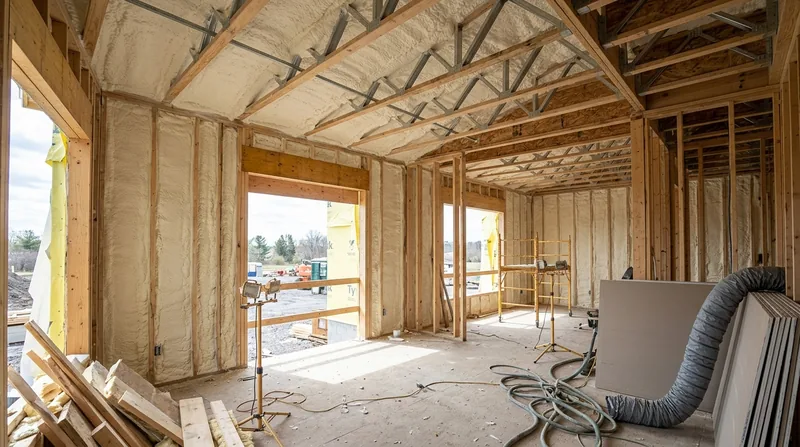




Commercial and new construction spray foam insulation in Utica is applied to building envelopes before walls close, sealing air leaks that would otherwise bleed heat through the entire heating season. Across Oneida and Onondaga counties, contractors and builders schedule foam work to align with the Mohawk Valley building calendar, where the window for construction runs tight and the heating load that follows demands an envelope sealed tight. New commercial shells, industrial retrofits, metal buildings, and residential development all benefit from the speed and air-sealing performance of spray foam applied at the framing stage. Whether your project sits in Utica proper, extends into New Hartford, Whitesboro, or Rome, or reaches across to Herkimer and Ilion, the principle is the same: foam applied before drywall and siding go up costs less to install and performs better than retrofit work done after occupancy. We work with general contractors and builders on schedules that fit the season, delivering written estimates with R-value and thickness specifications so every party knows exactly what is being installed and why.
Why Commercial and New Construction Spray Foam Matters in the Mohawk Valley
The Mohawk Valley building season compresses into a tight window. Spring thaw and fall frost limit the months when concrete is poured, framing is raised, and mechanical systems are rough-in. Spray foam applied during that framing stage seals the envelope before weather and occupancy loads hit it, and the cost to install it then is a fraction of the cost to retrofit it later. Commercial buildings and new residential construction face particular pressure on envelope performance because energy code in New York has tightened, and because the heating season here runs long and cold. A metal building or a new warehouse with an unsealed envelope will ice dam at the eaves, accumulate condensation inside the walls, and bleed conditioned air all winter. Foam applied at the sheathing stage or at the roof deck prevents that loss from day one.
- We spray closed cell or open cell foam on roof decks, wall cavities, and rim joists before the building closes to weather.
- We work with general contractors to fit foam application into the construction schedule without delay.
- We provide written estimates specifying R-value per inch and total thickness so code compliance and performance are documented from the start.
- We coordinate with local building departments on thermal barrier and ignition barrier requirements that vary by city and building class.
- We remove and replace failed insulation on renovation projects, clearing the cavity for new foam installation.
Envelope sealing at the frame stage is the most cost-effective point in the construction timeline to install spray foam insulation.
Key info: New York State building code governs thermal barriers, ignition barriers, and ventilation requirements for spray foam in commercial and residential construction. The fifteen-minute thermal barrier distinction between closed cell and open cell foam is the rule most builders get wrong. Always confirm the exact code in force at your address with the local building official before foam is ordered. We help navigate what applies at your site, but the building department has the final say.
For more detail on the foam types and their performance characteristics, see our closed cell spray foam insulation and open cell spray foam insulation pages.
How We Work on Commercial and New Construction Projects in Utica
Commercial and new construction jobs follow a clear sequence tied to the building schedule. Once framing is complete and mechanical rough-in is underway, we arrive on site to assess the envelope, confirm foam type and thickness with the general contractor and building official, and schedule the spray day. Foam application on a typical commercial shell takes one to three days depending on square footage and complexity. After cure, the building closes to weather and mechanical systems continue. We provide a written estimate before any work begins, specifying the foam type (closed cell or open cell), the thickness per application pass, the total R-value coverage, and the cost. Our crew arrives with equipment calibrated to the manufacturer ratio and drum temperature, applies foam in controlled passes to prevent thickness creep and poor adhesion, maintains mechanical ventilation during cure, and documents the work with photos and a completion report.
- We schedule foam application to fit the general contractor's timeline and the building's weather window.
- We verify the substrate is dry, clean, and free of standing water or active leaks before foam is applied.
- We apply foam in passes of controlled thickness, typically 1.5 to 2 inches per pass, so the material bonds correctly and achieves rated R-value.
- We maintain mechanical ventilation during cure and establish a re-entry window of twenty-four to forty-eight hours before the space is occupied or further work begins.
- We provide a written completion report with photos, foam type, total thickness, R-value achieved, and square footage covered.
Clear scheduling and documented installation protect both the contractor and the builder when code compliance and performance are on the line.
Example: A new light industrial building in New Hartford, 8,000 square feet, with a metal roof deck and masonry block walls. Closed cell foam, 2 inches thick on the roof deck for condensation control and air sealing, open cell foam in the wall cavities for sound dampening and cost efficiency. Estimate delivered within twenty-four hours, work completed in two days, R-value and thickness documented in the completion report. Final invoice tied to square footage sprayed and verified on site.
See our metal building and barndominium spray foam page for more on this application type.
Commercial and New Construction Spray Foam Methods and Approaches
| Approach | Description | Best for |
|---|---|---|
| Closed cell spray foam on roof deck | High-density foam (3.5 to 3.6 lbs/cubic foot) applied 1.5 to 2 inches per pass, creating a moisture and air barrier in one layer. | Metal buildings, unvented roof decks, condensation control in high-humidity environments. |
| Open cell spray foam in wall cavities | Low-density foam (0.5 to 0.7 lbs/cubic foot) filling wall cavities from sheathing to stud, providing air sealing and sound dampening without a separate vapor barrier. | New residential framing, office buildings, interior sound control, cost-effective envelope sealing. |
| Closed cell foam on rim and band joists | High-density foam applied to the band joist and rim area at the foundation, sealing the thermal break where the building meets the foundation wall. | New construction over basements, crawl spaces, or pilings, preventing air leakage and moisture intrusion at the foundation line. |
| Removal and replacement of existing insulation | We remove failed insulation, clean the substrate, and install new foam to specification, documenting the old material type and disposal method. | Renovation of commercial buildings, retrofit of residential additions, correction of undersized or damaged insulation from prior work. |
Commercial and New Construction Spray Foam Cost in Utica: What to Expect
The cost of spray foam insulation on a commercial or new construction project depends on the foam type, the thickness required by code and performance targets, the square footage to be covered, substrate condition, and site access. Closed cell foam costs more per board foot than open cell, but performs better in moisture-prone applications like metal roof decks and foundation rim joists. Open cell foam is less expensive and is the right choice for interior wall cavities in new residential framing where vapor management is not a concern. A new commercial shell with 8,000 square feet of roof deck and 4,000 square feet of wall cavity might run from $8,000 to $16,000 depending on foam type and thickness, while a smaller addition or retrofit retrofit could start at $2,000 to $4,000. We provide a free commercial estimate with R-value and thickness specifications so you know the cost before work begins. Travel is included across Utica and surrounding areas, and the estimate response time is within twenty-four hours. For detailed pricing guidance and to understand the factors that move the cost up or down, visit our pricing overview.
The single biggest factor affecting cost is the choice between closed cell and open cell foam. Closed cell is denser, stronger, and provides a moisture barrier, making it the choice for roof decks, crawl spaces, and foundation rim joists. Open cell is lighter, less expensive, and is the right answer for interior wall cavities in new framing where the building envelope is already managed by sheathing and exterior weather resistance. A general contractor who understands that distinction can make the right choice the first time and avoid the cost of retrofit correction. We help builders and property managers make that choice based on the specific application and code requirements at their site.
What to Look for When Hiring a Spray Foam Insulation Contractor Near Utica
The spray foam insulation trade has three categories of players: local independent shops with a local address and local plates, national franchise operations with corporate training and standardized processes, and rig-and-run crews from out of state who spray a job in an afternoon and are gone when the smell will not go away or the foam fails to cure. The local independent has the advantage of reputation and accountability. Before you hire any spray foam contractor, including us, verify that the company is fully insured and that the insurance is current and will cover the work. Ask for a written estimate that specifies the foam type, thickness per pass, total R-value, and the square footage to be covered. Confirm that the contractor will maintain mechanical ventilation during cure and will establish a clear re-entry window of twenty-four to forty-eight hours. Ask for references from recent commercial or new construction projects in Utica, New Hartford, Rome, or Herkimer. If your building is in a master-planned community or under HOA rules, confirm that the contractor understands any architectural restrictions on exterior work. If your project requires a permit, verify that the contractor has worked with the local building department on thermal barrier and ignition barrier requirements. Call us at (315) 737-6731 to discuss your project and request a free estimate.
- Verify the contractor is fully insured and can provide a current certificate of insurance before work begins.
- Request a written estimate specifying foam type, thickness, R-value, and total square footage, never a verbal price or a price per board foot without an on-site inspection.
- Ask whether the contractor will maintain mechanical ventilation during cure and will document the re-entry window in writing.
- Check references from similar projects completed in the past two years in your area.
- Confirm the contractor has experience with the local building code and will coordinate with the building official on thermal barrier and ignition barrier requirements.
Hiring a local, accountable spray foam contractor protects your project timeline, your budget, and your building's long-term performance.
Commercial & New Construction Spray Foam in Utica: Pricing Guide
| Service | Price | Details |
|---|---|---|
| Free commercial estimate | Free | Written estimate with R-value, thickness, foam type, square footage, and total cost, delivered within 24 hours |
| Closed cell spray foam on roof deck | Starting at $2.50 per board foot | High-density foam for metal buildings and unvented decks, moisture control, condensation prevention, typical 2-inch application |
| Open cell spray foam in wall cavities | Starting at $1.50 per board foot | Low-density foam for new residential framing, interior sound dampening, cost-effective air sealing, typical 3.5 to 5.5 inch cavity fill |
| Insulation removal and replacement | On estimate | Cost depends on material type, volume, and disposal method, assessed on site before work begins |
| Travel and site visit | Included | No separate mileage fee or travel charge for Utica and surrounding Oneida and Onondaga county areas |
Indicative pricing, the exact cost depends on square footage, finish, and site access. Free personalized estimate within 24h at (315) 737-6731.


