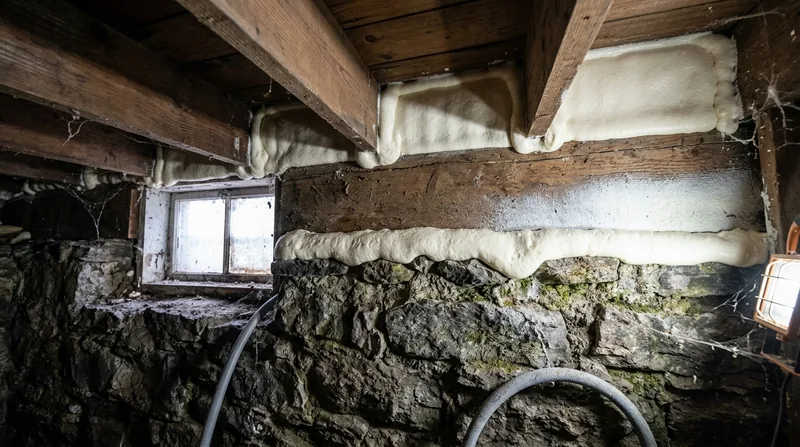




Rim joist and band joist spray foam insulation in Utica stops the heat loss that plagues homes built over stone or block basement walls. The rim joist is the band of wood or concrete that sits on top of your foundation wall and connects the basement to the first floor. In Utica, New Hartford, Rome, and across the Mohawk Valley, this zone leaks cold air all winter because it is rarely insulated properly, if at all. When outdoor temperatures drop below freezing for months at a time, the rim and band become a thermal bridge that pulls warmth out of your living space and draws cold basement air upward through wall cavities. We seal this perimeter with closed cell spray foam, stopping drafts, reducing condensation risk, and lowering the heating load your furnace has to fight.
Why Rim and Band Joist Insulation Matters in Older Utica Homes
Most homes in Utica, Herkimer, Clinton, and Rome were built over full basements with stone, block, or poured concrete foundations. The rim joist sits directly on that cold foundation, exposed to basement air that stays 45 to 50 degrees Fahrenheit year-round. In winter, the temperature difference between your heated first floor and that cold basement is 30 to 40 degrees. Without insulation at the rim, warm air leaks down into the basement and cold air rises into your walls and floor cavities. This creates a continuous convection loop that your heating system has to overcome every single day from November through March.
- Cold basement air rises through gaps and cracks around the rim, cooling the first floor and making it drafty near exterior walls.
- Warm indoor air moves down through wall cavities and into the basement, carrying moisture that condenses on cold foundation surfaces.
- The rim joist itself conducts cold directly into the floor system, making basement-adjacent rooms feel uncomfortable even with the heat running.
- Energy bills stay high because your furnace runs longer trying to maintain temperature while heat leaks away at this thermal weak point.
Sealing the rim with spray foam stops this cycle and pays dividends in comfort and utility savings over time.
Key info: Homes in East Utica and Cornhill with stone foundations, or mid-century ranches in New Hartford and Whitesboro with block basement walls, lose the most heat through uninsulated rim joists. A typical 1,500-square-foot home with 120 to 150 linear feet of rim joist can lose 10 to 15 percent of its total heating energy through this zone alone.
For more context on how air sealing works across your whole home, see our air sealing service page.
How We Seal Rim Joists and Band Joists in Utica Homes
We start with a site inspection to assess the rim joist condition, foundation type, and any existing insulation or moisture. We check for active water intrusion or dampness, because spray foam does not fix a leaking foundation. If the rim is wet or actively draining, we address that first or refer you to the appropriate specialist. Once the substrate is dry, we apply closed cell foam in thin, controlled passes to build up the specified thickness. Closed cell is the right choice here because it provides high R-value per inch, creates a vapor barrier that reduces condensation risk, and bonds to concrete, block, and wood.
- We inspect the rim joist and band area to confirm it is dry and free of active moisture before any foam is applied.
- We mask off areas that need protection and set up mechanical ventilation to manage off-gassing during the spray and cure period.
- We apply closed cell foam in controlled passes, typically 1.5 to 2 inches per pass, to achieve the target R-value and thickness specified in the estimate.
- We allow the full cure time of 24 to 48 hours before the space is reoccupied, and we provide clear guidance on ventilation and re-entry windows.
The result is an air-sealed, insulated rim joist that stops drafts and reduces the temperature gradient between basement and living space.
Example: A home in Yorkville with a 140-foot rim joist and a basement that stays 48 degrees in winter receives 3.5 inches of closed cell foam, yielding an R-value of approximately 21. The homeowner notices reduced drafts near the basement stairs and rim-adjacent walls within the first heating season, and heating run time decreases noticeably by mid-January.
For details on our closed cell spray foam process and R-value specifications, visit that service page.
| Approach | Description | Best for |
|---|---|---|
| Closed Cell Spray Foam | High-density foam applied in controlled passes to 3 to 4 inches, yielding R-20 to R-24. Creates a vapor barrier and air seal in one application. | Stone or block foundations where moisture risk is moderate and high R-value per inch is needed. |
| Rim Joist with Existing Fiberglass | Remove old batts or blown-in insulation, clean the rim surface, then apply 2 to 3 inches of closed cell foam over the band. | Homes where rim insulation was attempted but failed or settled, and air leakage is still present. |
| Basement Rim and Crawl Space Perimeter | Closed cell foam applied to the rim and down the band to the crawl space floor, sealing the entire perimeter zone in one job. | Homes with both basement and crawl space sections, or homes where the rim and band are the primary air leak source. |
| Rim Joist with Thermal Barrier | Closed cell foam applied and finished with a code-compliant thermal barrier (drywall or intumescent paint) where required by local building code. | Finished basements or basement apartments where foam must meet fire code thermal barrier requirements. |
Rim Joist and Band Joist Spray Foam Cost in Utica: What to Expect
Rim joist spray foam is one of the most cost-effective energy upgrades you can make, because the linear footage is small compared to an attic or crawl space, and the work is straightforward. A typical Utica home with 120 to 150 linear feet of rim joist and 3.5 inches of closed cell foam will fall in the $1,200 to $1,800 range. The price depends mainly on the length of the rim, the thickness of foam required to meet the R-value target, foundation type (smooth concrete pours are faster than block or stone), and accessibility. Basements with low headroom or tight rim spaces take longer and cost more. We provide a written estimate with R-value, thickness, linear footage, and total cost before any work begins.
- Linear footage of rim joist is the primary cost driver, ranging from 80 feet in a small cottage to 200 feet in a large ranch or colonial.
- Foundation type affects application speed: poured concrete is fastest, block or stone requires more prep and takes longer.
- Existing insulation that must be removed adds labor but ensures the foam bonds properly to a clean substrate.
- Basement accessibility and headroom determine how quickly our crew can move and spray, which affects total labor time and cost.
Getting 2 or 3 estimates from different contractors is always smart. Look for estimates that specify R-value and thickness, not just a price per linear foot. Our estimates include those details and a clear scope of work so you can compare apples to apples.
For a full overview of our pricing across all services, visit our pricing page.
Rim Joist and Band Joist Spray Foam Near Me: What Utica Homeowners Should Know When Hiring
Spray foam insulation is a specialized trade, and the quality of the install depends entirely on the contractor's knowledge, equipment, and discipline. A poorly done rim joist job will still look like it worked at first, but if the foam is applied too thick in one pass, not at the manufacturer ratio, or without proper ventilation during cure, it can off-gas for weeks and create odor complaints. Before you hire any contractor, verify their insurance and ask for references from recent jobs in your area. Do not accept a price quote that has no R-value or thickness specification. Ask how they manage off-gassing and what the re-entry window is. If a contractor promises immediate occupancy or says the smell will disappear in a day or two, that is a red flag.
- Confirm the contractor carries liability and workers compensation insurance and can provide a certificate of insurance before work begins.
- Request written estimates from at least two contractors and compare the R-value, thickness, and total linear footage specified in each.
- Ask for references from three recent rim joist jobs and follow up with those homeowners about their experience and satisfaction.
- Verify that the contractor understands local building code requirements for your address, including any thermal barrier or ventilation rules.
- Confirm the work scope in writing, including prep, application method, cure time, and any cleanup or finish details.
We are fully insured and have been in business since 2012, serving Utica, New Hartford, Rome, Clinton, Herkimer, and the surrounding Mohawk Valley. We provide written estimates with R-value and thickness specs, and we are happy to discuss our process and answer any questions before you decide to move forward. Call us at (315) 737-6731 for a free estimate with no obligation.
For more information on how to get started, visit our contact and free estimate page.
Rim Joist & Band Joist Spray Foam in Utica: Pricing Guide
| Service | Price | Details |
|---|---|---|
| Standard rim joist sealing | Starting at $1,200 | 120 to 150 linear feet of rim joist with 3.5 inches of closed cell foam, yielding R-20 to R-24 per estimate specifications |
| Rim joist with existing insulation removal | Starting at $1,400 | Removal of old fiberglass batts or blown-in insulation, substrate cleaning, and 3 inches of closed cell foam application |
| Extended rim and band joist coverage | Starting at $1,800 | Rim joist plus band joist and crawl space perimeter in same application, 160 to 200 linear feet total with full R-value specification |
| Rim joist with thermal barrier finish | On estimate | Closed cell foam plus code-compliant thermal barrier (drywall or intumescent paint) for finished basements or rental units |
| Estimate and site visit | Free | No obligation consultation, written estimate with R-value and thickness specs, response within 24 hours at (315) 737-6731 |
Indicative pricing, the exact cost depends on square footage, finish, and site access. Free personalized estimate within 24h at (315) 737-6731.


