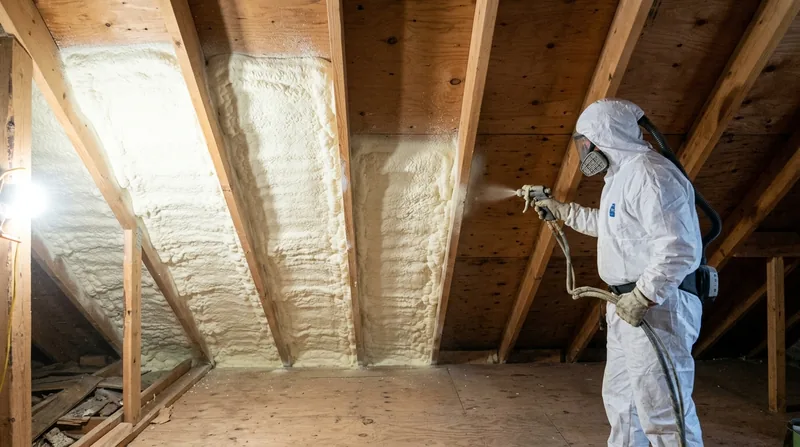




Older homes across Utica, New Hartford, Whitesboro, and the surrounding Mohawk Valley were built with insulation that fails. Victorian and early twentieth-century stock in East Utica and Cornhill often has thin or missing wall cavity fill. Mid-century ranches in New Hartford sit over rim and band joists that leak heat all winter. Vented attics collect moisture from indoor air during cold months, then ice dams form along the eaves when weak insulation lets warm air reach the roof sheathing. After removal of failed fiberglass or old foam, insulation replacement and re-insulation restores the thermal and moisture control these homes need. We install open or closed cell spray foam sized for your attic, walls, rim joists, and crawl spaces, built for the long heating season and humid summers of this region. Call us at (315) 737-6731 for a free written estimate, or learn more about our attic spray foam insulation service.
Why Insulation Replacement Matters in Utica's Cold Climate
The Mohawk Valley winter is relentless. Heating bills climb because air leaks through rim joists, top plates, and attic edges faster than old insulation can resist. Older homes near the Mohawk River often sit on stone or block foundation walls that are cold and damp, with rim boards that have settled and cracked over decades. Ice damming on roofs is the visible failure: warm air from a poorly insulated attic melts snow at the eave, water backs up under shingles, and by spring you have stains on ceilings and rotted sheathing. Wall cavities in homes built before 1980 are often empty or thinly filled with degraded fiberglass. Humid indoor air in summer and winter moisture from breath and cooking move into those cavities, condense on cold surfaces, and promote rot. Replacement insulation stops these failures at the source.
- Remove old, failed, or contaminated insulation before any new material goes in.
- Install closed cell or open cell foam at the correct thickness and R-value for your climate zone.
- Seal air leaks at rim joists, top plates, band joists, and penetrations so conditioned air stays inside.
- Control moisture by creating a thermal and air barrier that stops the dew point from landing inside cavities.
- Meet or exceed the thermal resistance required by the energy code in force at your address.
The result is lower heating bills, fewer ice dams, and walls and attics that stay dry year-round.
Key info: A Utica home with an uninsulated rim joist and a vented attic with R-19 fiberglass can lose 20 to 30 percent of its heating energy through those two zones alone. Replacement with closed cell foam at the rim and a sealed roof deck stops that leak cold.
For details on the removal side of the job, see our insulation removal service page, which covers the safe extraction of old material before new foam is installed.
How We Handle Insulation Replacement in Utica: The Process
Replacement insulation starts with assessment and removal. We inspect the existing insulation, identify moisture, contamination, or settling, and remove it to bare substrate. Once the cavity or deck is clean and dry, we measure the space, calculate the R-value and thickness needed for your climate, and install open or closed cell foam in controlled passes. Closed cell is denser and more moisture-resistant; open cell is lighter and more cost-effective for attics where moisture control is less critical. Both are sprayed to the thickness specified in writing, then trimmed flush with the framing. We do not re-enter or occupy the space until the foam has cured fully, typically 24 to 48 hours depending on conditions and product.
- Schedule a free written estimate with R-value and thickness specifications for your home.
- We remove old insulation, debris, and any contaminated material to bare wood or masonry.
- Substrate is inspected for moisture, leaks, or structural damage and repaired before foam is applied.
- Spray foam is applied in controlled passes at the manufacturer-specified ratio and temperature.
- Mechanical ventilation runs during cure to manage off-gassing and ensure proper curing.
- We trim excess foam flush with framing and seal any voids or gaps.
- A re-entry window of 24 to 48 hours is stated in writing before you occupy the space.
This step-by-step approach ensures your new insulation performs as designed and lasts for decades.
Local example: A 1950s ranch in New Hartford with a vented attic and R-19 fiberglass over the main floor, plus uninsulated rim joists over the basement, typically receives 5.5 inches of closed cell foam at the rim and 6 inches of open cell at the attic deck, bringing the attic to R-23 and the rim to R-33. Total project cost starts around $3,500 to $4,200 depending on attic size and access. A free estimate pinpoints the exact scope and price for your home.
Learn more about our closed cell spray foam and open cell spray foam options to understand which is right for your job.
Insulation Replacement Methods: Closed Cell vs. Open Cell
| Approach | Description | Best for |
|---|---|---|
| Closed Cell Spray Foam | High-density foam (1.5 to 2 lb/cu ft) with closed cell structure. Resists moisture and air infiltration. R-value around 6 to 7 per inch. | Rim joists, band joists, basement walls, sealed attics, and cold climates where moisture control is critical. |
| Open Cell Spray Foam | Lower-density foam (0.4 to 0.5 lb/cu ft) with open cell structure. Allows vapor transmission. R-value around 3.5 to 4 per inch. | Vented attics, interior walls, and sound dampening where cost is a priority and moisture is controlled by ventilation. |
| Blown-In Fiberglass or Cellulose Top-Up | Loose-fill insulation blown into cavities. Lower cost per R-value. Does not air seal. | Adding depth to an existing sound attic with no air leaks, or as a budget option when spray foam is not the right fit. |
| Injection Foam for Closed Walls | Low-pressure foam injected through small holes into wall cavities without demolition. Fills voids and hardens in place. | Pre-1980 homes with empty or thin wall cavities, plaster walls, and buildings where opening walls is not practical. |
Each method has a place. Closed cell is the premium choice for moisture-prone zones; open cell is the sensible pick for attics in dry climates or where sound control matters. Blown-in is sometimes the right answer and we say so plainly. Injection foam is the only option for retrofit wall cavities without demolition.
Insulation Replacement and Re-Insulation Cost in Utica: What to Expect
Replacement insulation in Utica typically starts at $2,800 for a smaller attic or rim joist project and rises with the square footage of the space, the R-value required, the type of foam chosen, and the condition of the substrate. A full attic replacement on a mid-sized home often runs $3,500 to $5,000. Rim and band joists alone are $1,500 to $2,500 depending on the linear footage and access. Wall injection on a 1,500-square-foot home with empty cavities ranges from $2,200 to $3,500. Crawl space replacement is priced by the square footage and whether we are sealing the rim, the band joist, or the entire perimeter.
Cost is driven by the square footage of the space, the R-value and thickness required by code at your address, the choice between closed cell and open cell, access difficulty (tight attics or crawl spaces cost more), and whether the substrate is wet or contaminated and must be repaired before foam is applied. A home with an accessible attic and clean framing will cost less than one with a cramped space or water damage that must be addressed first. We always provide a written estimate with R-value, thickness, foam type, and total price before any work begins.
Getting 2 to 3 estimates from qualified contractors is the smart move. Compare not just price but the R-value and thickness specified, the foam type recommended, the warranty on workmanship, and the re-entry window promised. The lowest bid is often a red flag if it omits thickness specs or promises immediate occupancy.
For a detailed breakdown of pricing by service type and region, visit our full pricing overview. Call us at (315) 737-6731 to schedule a free estimate with no obligation.
What to Look for When Hiring an Insulation Replacement Contractor Near Me in Utica
The spray foam insulation trade has two types of operators: local shops with a local address and trucks that stay put, and out-of-state trailer crews that spray a job in an afternoon and disappear. The local independent is positioned against both. When you hire a contractor for insulation replacement, verify that they are fully insured and that the certificate can be provided on request. Ask for references from jobs completed in Utica or nearby towns within the last two years, and call at least two of them. Get a written estimate that specifies the R-value, foam thickness in inches, foam type (closed or open cell), total square footage, and the warranty on workmanship. Never accept an estimate with no R-value or thickness; that is a sign of poor workmanship or a contractor who does not know the code.
Ask whether the contractor will handle all permits required at your address. Permitting rules for insulation vary by city across Utica, New Hartford, Rome, Herkimer, and Clinton, and there is no reciprocity between jurisdictions. The contractor should know the local building department and the thermal barrier and ventilation rules that apply to your specific address. If your home is in a historic district or an HOA community, ask whether architectural approval is needed before work begins. For crawl space work, ask about moisture control: we will not spray over a wet substrate, and if water is present, it must be addressed first or we walk away.
Verify that the contractor uses mechanical ventilation during cure and specifies a re-entry window of 24 to 48 hours in writing. Promises of immediate re-entry are a marker of poor practice. Ask about the curing process and off-gassing: low-VOC foam cures odorless within 48 hours, but the space should be ventilated during that window. Finally, confirm that the warranty on workmanship is stated in writing and that it covers defects in application, not just material failure.
Ready to get started? Contact us at our contact page to request a free written estimate with no obligation. We respond within 24 hours and will walk you through the entire process.
Insulation Replacement & Re-Insulation in Utica: Pricing Guide
| Service | Price | Details |
|---|---|---|
| Attic Replacement (Vented or Sealed) | Starting at $2,800 | Open or closed cell foam to specified R-value, includes removal of old insulation, substrate inspection, and trim work |
| Rim and Band Joist Replacement | Starting at $1,500 | Closed cell foam 4 to 6 inches thick, includes air sealing and moisture barrier, priced by linear footage and access |
| Wall Injection Foam Retrofit | Starting at $2,200 | Fills empty cavities in closed walls without demolition, typical 1,500 sq ft home, priced by wall area and cavity condition |
| Crawl Space Replacement | Starting at $3,000 | Foam at rim, band, and perimeter, includes moisture assessment and substrate prep, priced by square footage and access |
| Complex or Large-Scale Job | On estimate | Multiple zones, wet substrate repair, difficult access, or contaminated material removal requires on-site assessment |
| Free Written Estimate | No charge | Includes R-value, thickness, foam type, square footage, and labor estimate, response within 24 hours at (315) 737-6731 |
Indicative pricing, the exact cost depends on square footage, finish, and site access. Free personalized estimate within 24h at (315) 737-6731.


